Here Comes Another Twist In The Charlie Kirk Murder Case — Judge For Yourself
The back-and-forth is enough to give a guy whiplash. Here's the latest update


The last time a Charlie Kirk update came to light, everyone and their dog had an opinion about it, usually based on the headline itself and not the actual story context. Another data point has been added to the fact pattern. Make of it what you will.
For those who missed it, we’ll begin with the recap of two weeks ago.
For those who know all about the Defense filing and the ATF’s inconclusive report about the round that killed Charlie, you can skip down to the part where we share the ATF’s findings.
For the TL;DR folks, skip to the bottom where I summarize (with some direct quotes from the report which is included in this article) what the new wrinkles in the debate are.
The Recap
A couple of weeks ago, the Daily Mail made a big splash with a what turned out, on closer inspection, to be a click-bait-y headline.
The headline? Bullet used to kill Charlie Kirk did NOT match rifle allegedly used by suspect Tyler Robinson, new court filing claims
The content of the story was pretty straightforward. The defence team was pushing for a six-month extension before the trial begins. DNA evidence needs some further processing. They want to challenge some of the evidence-gathering or assessment steps. And they wanted to use an ATM firearms analysis as ‘exculpatory evidence’ to exonerate the defendant. But the real money quote causing a stir in the article was this one.
“But his defense attorneys now argue that the Bureau of Alcohol, Tobacco, Firearms and Explosives ‘was unable to identify the bullet recovered at autopsy to the rifle allegedly tied to Mr Robinson.'”
The counter-argument to that story was not that it had been ruled out in the sense of positive negation, but that it was ‘inconclusive’, neither proving nor disproving the case.
PolitiFact spoke to forensic science and criminology experts who said an “inconclusive” finding on a bullet fragment like this is not uncommon, and it does not rule out that the weapon used in Kirk’s killing was the same one linked to Robinson.
“When the results of a bullet fragment analysis come back as ‘inconclusive,’ that does not mean that the rifle did not fire the bullet,” Christopher Ballard, a spokesperson for the Utah Country Attorney’s Office and part of the prosecution team, wrote in an email to PolitiFact. “There just aren’t enough marks on the fragment to make a conclusion one way or the other as to whether the bullet fragment was fired by the particular rifle.”
It is also incorrect to say that the bullet “did not match” the rifle, the experts said. The bullet may simply be too small or too deformed for examiners to provide an accurate analysis. — PBS
(Note: left-of-center PBS was cited here rather than quoting a site like FoxNews that could be accused of presuming the defendant’s guilt.)
Our own Doug Giles has been vocal from the very beginning, saying this case sounds bogus to him, not because he’s lining up behind any of the grifters with a bone to pick against TPUSA, Erica Kirk or the groundswell of conspiracy theories popping up in those circles. His objection is simple. He has a real time that a 30/06 round can be stopped cold and come to rest in the neck of a person. In his experience, the energy of such a round would keep on going.
Based on what he knows about guns, he figures they’ve got the wrong guy. And he might yet be proven right about that.
But that was two weeks ago. The public did NOT have the results of the ATF’s study.
That was then. This is now. Their findings have been released. which brings us to the NEXT plot twist… the defense characterization of the evidence wasn’t telling the whole story.
THE ATF’S FINDINGS
Andrea Burkhart (@aburkhartlaw) shared an update (link to original) of the findings giving the following summary of the documents she attached:
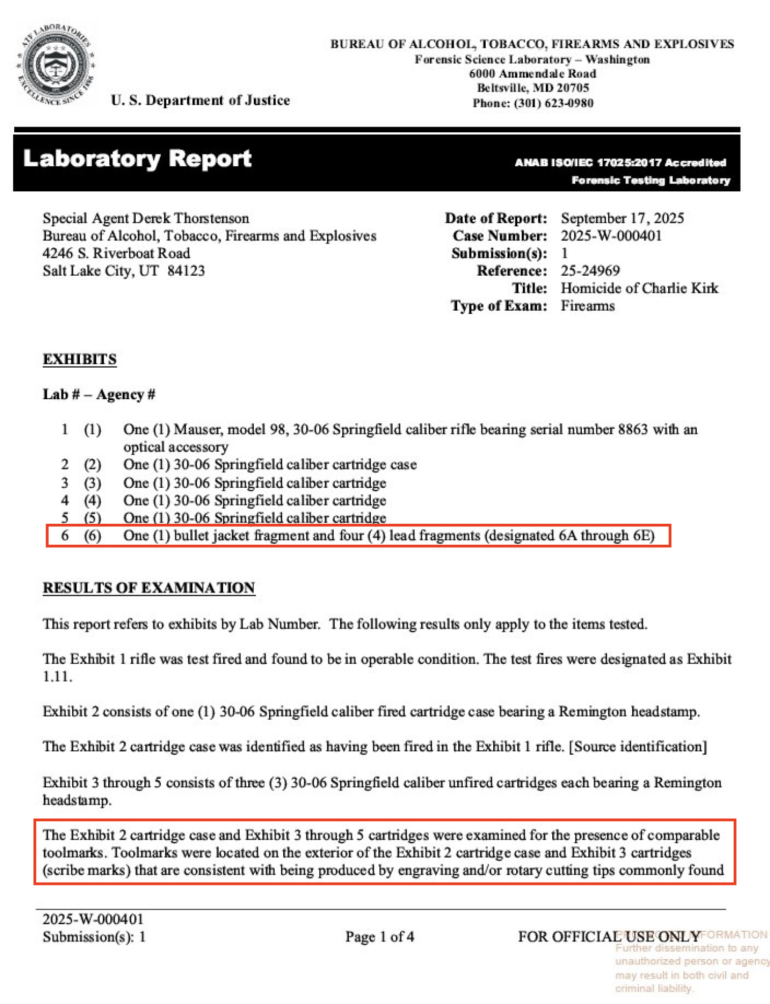
1 bullet jacket fragment and 4 lead fragments were recovered during Charlie’s autopsy,
The jacket is identified as coming from a .30 caliber class bullet.
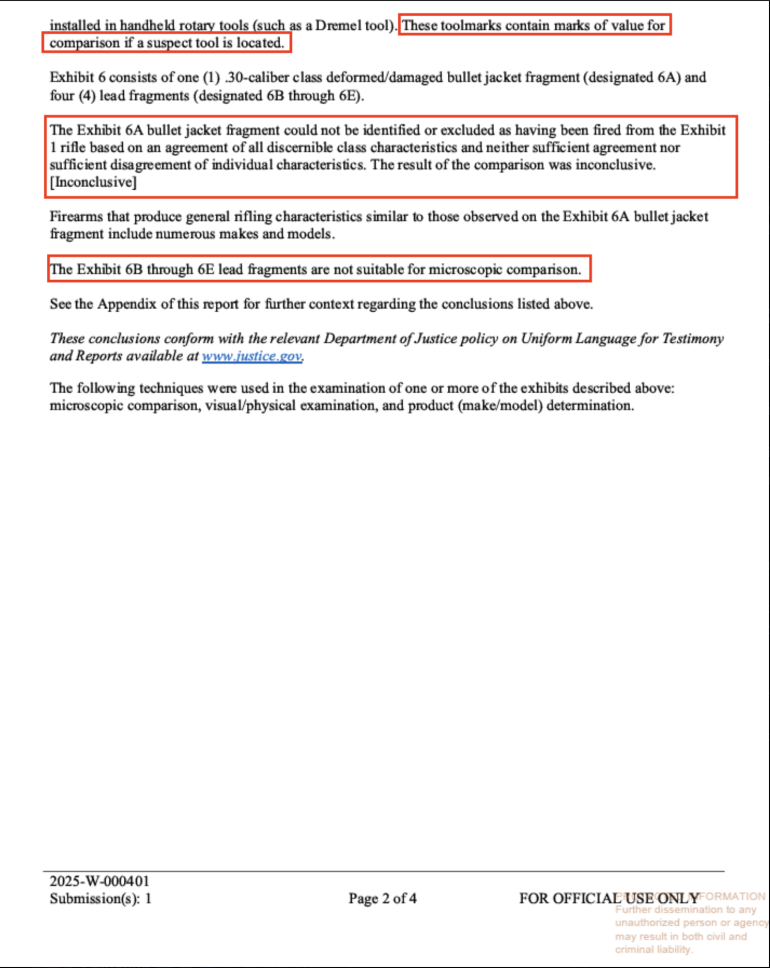
The jacket fragment shared class characteristics with Tyler Robinson’s Mauser 98 rifle, so the rifle couldn’t be excluded as having fired the bullet. But the fragment lacks individual characteristics permitting identification of one rifle to the exclusion of all others in the class.
The engravings on the cartridge casings are consistent with a rotary tool like a Dremel.
According to the motion, the State now wants to conduct Virtual Comparison Microscopy (VCM) on the jacket casing, a new technology in which the item is 3D scanned and virtually compared to a test fire. This might require the analyst to “unfold” deformed portions of the jacket, which could leave marks from the tool used to unfold the material. It could also potentially affect the structural integrity of the jacket fragment; an FBI analyst who received the fragment from the ATF noted that part of the jacket fragment has become detached in the packaging.
The State also wants to do “metallurgical” testing of a lead fragment, the precise nature of which is unspecified.
The defense filed the January 9th motion after they requested to be able to photograph the jacket casing in its current state and to attend or photograph any future testing, and its requests were denied. The motion is requesting that testing not be allowed to proceed without these conditions in place to protect the defense’s ability to evaluate the testing.
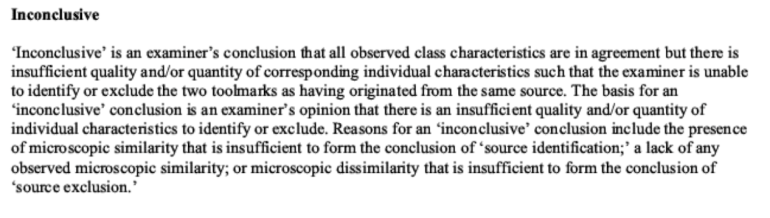
The remaining two pages (which can be found in the source tweet, above) include a page identifying the people involved in the report, and an appendix page explaining how certain terms are used. The one defining ‘inconclusive’ stood out as relevant, and is included here:
What does any of this new information tell us?
Let’s start with some of the stated evidence in the report, in no particular order:
- The bullet in question broke into several pieces: 1 damaged bullet jacket, and 4 lead fragments
- The recovered fragments have been judged ‘not suitable’ for microscopic examination to be of any value.
- Toolmarks may be helpful in matching the suspected tool with which the messages were engraved on the shells
- The cartridge recovered has been identified as a 30-06 Remington
- Exhibit 6 identifies the round recovered from the fatal wound as a “.30 caliber class deformed/damaged bullet jacket fragment (6A) and four (4) lead fragments (designated 6B through 6E)”
- The part that was determined as ‘inconclusive’ was specifically: “the (6A) jacket fragment could not be identified or excluded as having been fired from the (Exhibit 1) rifle based on an agreement of all discernible class characteristics and neither sufficient agreement or sufficient disagreement of individual characteristics.”
The evidence the ATF is providing points to a 30-06 round that broke apart after impact, but does NOT conclusively match or rule out the spent round to the empty casing.
Of course, the report will not put the an end to the conversation.
Opinions will continue to abound on either side. Probably long after the jury renders a verdict.
But as the debates rage on, at least you will have access to the most current update on the hotly-debated lethal round.