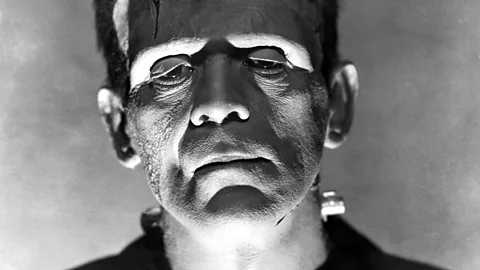
Frankenstein. A 19th Century horror novel written by Mary Shelley about a man who uses human body parts in attempt to re-create life, and in doing so produces a human-like creature.
Mary Shelley came up with the idea for such a novel in 1816 during a gathering in Geneva with her lover and soon-to-be husband Percy Shelley, her stepsister Claire Clairmont, the poet Lord Byron (whom Claire was having an affair with), and Lord Byron’s physician Dr. John Polidori. After listening to several ghost stories one night, Lord Byron proposed that everyone should write their own ghost story/horror story. Soon afterwards, Mary, while trying to come up with a story, had a waking dream in which she saw a hideous creature near her bedside staring down at her. And thus, she had the idea for her story.
Aside from this waking dream, Mary Shelley was inspired by the scientific minds of the day. One such individual was Luigi Galvani, who engaged in the practice of medical electricity by conducting experiments in which he applied electrodes to dead frogs, and whom the term galvanism originated. Such experiments would be continued by his nephew Giovanni Aldini, whom also inspired Mary. And another individual was Andrew Ure, a Scottish intellectual who carried out similar experiments on human corpses.
Yet another individual whom is said to inspired Mary Shelley was Johann Konrad Dippel, who was a theologian, physician, and alchemist. Dippel, carrying out his alchemist experiments, created a concoction which he named “Dippel’s oil”, which consisted of bone fragments, blood, and even flesh of animals. Such a concoction, he believed, would prolong life. Dippel was also said to have dug up corpses for medical experiments.
Mary Shelley is believed to have heard about Dippel when she and Percy were traveling along the Rhineland in 1814, for Dipple was born in a castle in the area known as Burg Frankenstein, which was built in the 13th Century by a German noble named Lord Conrad II Reiz of Breuberg and took the name Frankenstein, which in German means rock or stone of the Franks.
Some claim Mary and Percy visited the castle, despite its distance from the Rhine River. It is possible they just saw the castle from a distance, or perhaps just heard about it.
Nevertheless, Mary Shelley’s knowledge of the castle gave her the name for her novel. And although Frankenstein is supposed to be the name of the scientist and not the monster, one can argue the monster can be referred to as Frankenstein since Dr. Frankenstein is viewed as the creature’s father.
It should be noted that the novel had two themes (or perhaps morals): the dangers of scientific experimentation and the suffering caused by judging one by his or her appearance. Would plastic surgery and makeovers fall into both categories?
At any rate, Frankenstein eventually became one of the best-known horror novels of all time, and the story found its way onto the silver screen. Boris Karloff’s portrayal of the monster in 1931 is the most famous portrayal, despite the screenplay being different from the plot of the novel.
Happy Halloween.
