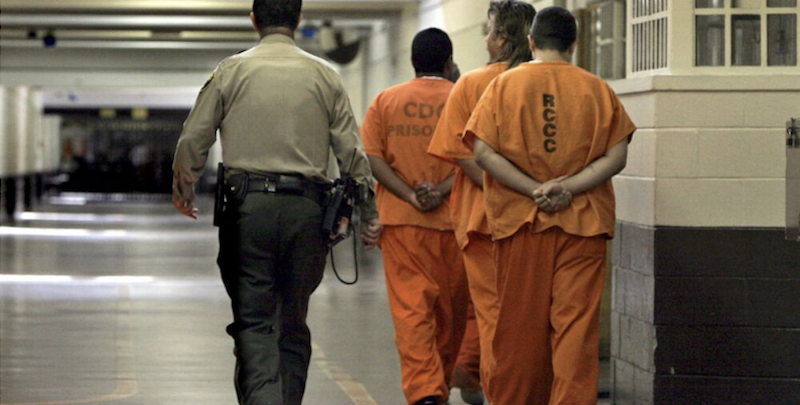
There is a cruel irony buried inside America’s correctional system. We spend enormous resources trying to rehabilitate the people behind bars, while too often overlooking the men and women we pay to stand guard over them. We offer counseling to the inmates, addiction treatment to the inmates, anger management to the inmates, and countless programs designed to help them rebuild their lives. Meanwhile, the people who walk into those same prisons every morning, absorb the violence, witness the depravity, and carry that darkness home to their families are frequently left to figure out how to survive it themselves.
And sometimes, they don’t.
The arrest of Massachusetts Republican lieutenant governor candidate Shawn Oliver following a multi-vehicle crash in New Bedford Saturday night has understandably generated headlines. Oliver faces charges including operating under the influence, negligent operation, speeding, and a marked lanes violation. These are serious allegations involving conduct that could have cost innocent people their lives. They deserve serious consequences if proven.
But there is another conversation worth having. One that extends far beyond a political campaign, a damaged vehicle, or a single terrible night.
Former Norfolk County Sheriff and former Boston City Council member Jerry McDermott believes America has been ignoring a crisis inside its correctional institutions for far too long. And unlike the political commentators rushing to dissect the electoral implications, McDermott has actually walked the halls, supervised the institutions, and spoken with the officers who live this reality.
During a conversation about Oliver’s arrest, McDermott described something that profoundly disturbed him during his tenure as sheriff from 2018 through 2020.
“We have numerous programs for the inmates,” he explained, describing social workers, medication-assisted treatment, individual and group therapy, Alcoholics Anonymous, and anger management classes. “But I saw very little being done to address this high-stress job.”
Think about that for a moment.
We recognize that incarceration can be psychologically devastating for the incarcerated. Yet somehow, we have failed to fully reckon with what decades of working inside those institutions can do to the people entrusted with maintaining order.
Corrections officers are not simply employees who punch a clock and go home. They spend eight, twelve, sometimes sixteen hours surrounded by people experiencing some of the darkest chapters of their lives. They encounter threats, manipulation, violence, mental illness, addiction, and human suffering that most Americans will never witness firsthand.
Then they are expected to drive home, sit down at the dinner table, help their children with homework, kiss their spouses goodnight, and behave as though they have just returned from an ordinary day at the office.
There is nothing ordinary about it.
McDermott put it into words that should haunt every policymaker responsible for these institutions.
“You’re going to jail,” he said, describing the reality of a twenty- or thirty-year career in corrections. “You’re dealing with some of the toughest people. You’re seeing people at their worst, and you’re trying to be your best.”
And, as he pointed out, there is no way to unsee what they have seen.
The research supports his broader concern. The National Institute of Justice has documented substantial psychological and physical health risks among correctional officers. Research highlighted by the agency has found elevated rates of post-traumatic stress symptoms and suicide, while federal occupational health researchers have identified violence, burnout, irregular schedules, and chronic stress as significant hazards of the profession.
One National Institute of Justice review reported that 27 percent of officers in a study of more than 3,000 corrections professionals exhibited symptoms of post-traumatic stress disorder. That is not some abstract workplace wellness problem. Those are human beings carrying extraordinary burdens.
And those burdens don’t disappear when their shifts end.
They follow them into their marriages, their parenting, their sleep, and sometimes into the bottom of a bottle.
To be clear, there is no established evidence that Oliver’s arrest resulted from occupational trauma, an addiction disorder, or an attempt to self-medicate. McDermott raised that possibility based on his experience with corrections officers, but it remains a possibility, not a diagnosis.
And that distinction matters.
Compassion does not require us to manufacture an excuse. Nor does accountability require us to abandon our humanity.
Mike Minogue, the Republican gubernatorial candidate whose ticket has now been thrown into turmoil, publicly condemned the alleged conduct and called upon Oliver to suspend his campaign. He also offered to help Oliver if he needs assistance. McDermott commended that combination of consequences and compassion.
There is a meaningful distinction between helping a person and excusing what that person has done. We should be capable of understanding it.
A person can be held accountable for dangerous behavior while still being treated as a human being worthy of help. Those principles are not mutually exclusive. In fact, a functioning society ought to insist upon both.
And this should not be a partisan issue.
Substance use disorders do not check voter registration cards. Depression does not discriminate between Republicans and Democrats. Trauma does not care who won the last election. Anyone attempting to turn addiction or psychological suffering into a convenient political weapon should remember that these problems exist in every community, every profession, and every political party.
The public has every right to demand responsibility from those seeking office. It also has every reason to demand something better from the institutions employing the people who protect us.
Where are the comprehensive, confidential mental health programs for corrections officers? Where are the routine trauma assessments, meaningful family-support services, accessible addiction treatment, and policies that allow officers to seek help without fearing that their careers will be destroyed?
Some departments have made progress. Others have not. The question is whether these protections are treated as essential infrastructure or optional benefits.
And why do we so often wait until someone has suffered a catastrophic personal or professional collapse before deciding that perhaps they needed help?
McDermott was equally emphatic that this conversation must extend beyond corrections officers to police, firefighters, emergency medical personnel, and other first responders who routinely encounter tragedy and human suffering.
We praise these men and women at ceremonies. We thank them at community events. We call them heroes when they run toward danger while everyone else runs away.
But gratitude without meaningful support is little more than a public relations exercise.
The people who spend their working lives protecting society should not have to sacrifice their own psychological well-being to do it.
Whatever happens to Shawn Oliver, the criminal allegations must be addressed on their merits. His political future is a separate question, and the people of Massachusetts are entitled to expect accountability from anyone seeking public office.
But if the only lesson we take from this incident is that a political campaign has suffered an embarrassing setback, we will have missed an opportunity to confront something far more consequential.
There are thousands of men and women walking into America’s correctional facilities today, carrying burdens the public rarely sees and may never understand. Some are struggling quietly. Some are afraid to ask for help. Some have convinced themselves that suffering is simply part of the uniform.
And some may be much closer to breaking than anyone realizes.
We have spent generations asking how to rehabilitate the people inside our prisons.
Perhaps it is time we asked who is taking care of the people we pay to guard them.
Because a society that remembers the humanity of its prisoners but forgets the humanity of its protectors has a problem no prison wall can contain.
