A Slave Revolt That Resulted in America’s Expansion
In an unlikely chain of events, Haiti played a role in setting up the Louisiana Purchase

The Louisiana Purchase. The purchase of the Louisiana Territory that doubled the size of the United States at the cost of $15 million. It also resulted in the Lewis & Clark Expedition.
But how did this purchase come to be? It all started during the Napoleonic Wars, when France convinced Spain to return the Louisiana Territory (which the French gave to the Spaniards in the aftermath of the French & Indian War as compensation for Spain being France’s ally).
Meanwhile, the United States (which had access to New Orleans under Pinckney’s Treaty with Spain) feared that the acquisition of the Louisiana Territory by the French posed a threat, considering Napoleon’s attempted conquest of Europe, as well as America’s quasi-war with France during the 1790s.
It is unclear if Napoleon was contemplating any military conquests throughout North America. But at any rate, the United States offered to buy New Orleans from France and West Florida from Spain. Surprisingly, Napoleon offered to sell not just New Orleans, but all of the Louisiana Territory. Although the Jefferson Administration was concerned if such a purchase was constitutional (since the Constitution was silent on the matter), the United States bought the Louisiana Territory on the grounds that Napoleon might change his mind and an opportunity would be lost. West Florida, meanwhile, remained in Spanish hands.
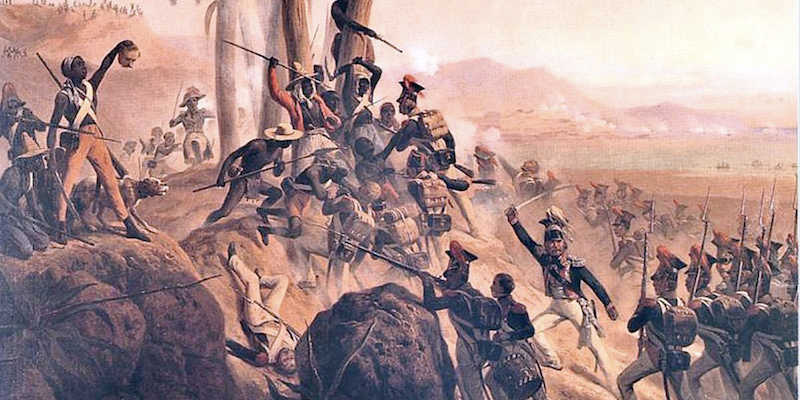
So why did Napoleon offer to sell the Louisiana Territory? It was the result of a 1793 slave revolt in present-day Haiti, which at the time was French colony St. Domingue. The revolt, led by General Toussaint L’Ouverture, led Napoleon to send 20,000 soldiers to put down the revolt and thus have a base in order to have control of Louisiana. However, an outbreak of yellow fever decimated the ranks of the French soldiers, and St. Domingue achieved its independence from the French. Later, St. Domingue would be renamed Haiti.
Thus, with his hopes of having colonies in the Americas thwarted and the needing money for his campaigns in Europe, Napoleon decided to sell all of the Louisiana Territory. As a result, any potential threat by France was eliminated, and the United States had doubled its size.
The irony of these events is that a slave revolt (something that many slaveowners feared) would result in the expansion of the United States, which was beneficial in the eyes of those who wanted the new lands to be open to slavery. Another irony was that James Madison (Thoms Jefferson’s Secretary of State) had secretly sent help to L’Ouverture’s forces during their revolt against the French. Even more ironic, the Louisiana Purchase was made via U.S. bonds from Alexander Hamilton’s U.S. Bank Initiative, which Jefferson saw as unconstitutional.
Despite all the irony, the United States had expanded due to the Louisiana Purchase, which is regarded as the greatest achievement of the Jefferson Administration.